Transform Your Web Applications with AI Agents: The Future of User Interaction is Here

Introduction: Why Every Web Application Needs an AI Agent
The Challenge: Complexity Overwhelming User Experience
Modern enterprise applications face a critical usability crisis. Consider a typical scenario: managing 50+ servers through a monitoring dashboard. Users must:- Navigate through multiple menus and interfaces
- Remember where specific features are located
- Manually correlate data from different sections
- Perform repetitive tasks across similar resources
How AI Agents Transform Application Interaction
Understanding AI Agent Architecture
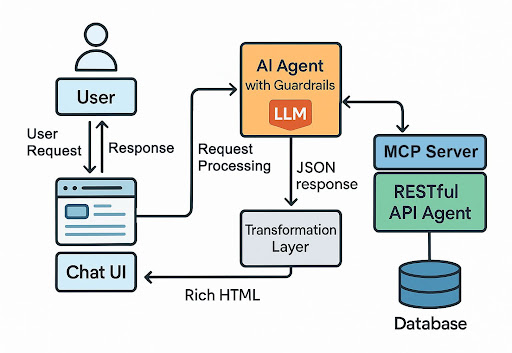
- User Interaction Layer: Users communicate through a Chat UI using voice or text
- AI Agent with Guardrails: The core orchestration engine powered by an LLM
- MCP Server Integration: Connects to your existing RESTful APIs
- Transformation Layer: Converts raw data into rich, presentable HTML
- Direct Database Access: Optional direct data retrieval when needed
- Task Understanding: Users describe what they want in natural language
- Tool Selection: The agent autonomously determines which tools and APIs to use
- Sequential Processing: It figures out the optimal order of operations
- Adaptive Response: Results are transformed into the most appropriate format
Real-World Implementation: The G8keeper Case Study
Our demonstration with G8keeper, a server monitoring application, showcases the transformative power of AI agents: Traditional Approach:- Navigate to server list
- Select specific server
- Find CPU usage section
- Interpret graphs manually
- Repeat for multiple metrics
- User asks: “Show me CPU usage for test server for last 15 minutes”
- Agent automatically retrieves, processes, and visualizes the data
- Results appear instantly in charts and tables
Key Capabilities That Set Our Solution Apart
1. Zero Code Integration
The most remarkable aspect of our AI agent implementation is its non-invasive nature:- Complete separation from existing application code
- Works through existing RESTful APIs or database connections
- Deploys as an independent layer
- No risk to production systems
2. Multi-Modal Communication
Users interact naturally through:- Voice Commands: Speak requests in any language
- Text Input: Type queries in natural language
- Mixed Inputs: Combine voice and text seamlessly
- Multilingual Support: Demonstrated with English and Hindi, extensible to any language
3. Intelligent Memory Management
Our agents don’t just respond—they remember:- Store important data points for future reference
- Compare current state with historical data
- Track changes over time
- Provide context-aware responses
4. Dynamic Visualization
Unlike static dashboards, AI agents create visualizations on demand:- Generate charts based on specific queries
- Format data optimally for each use case
- Combine multiple data sources intelligently
- Present information in the most consumable format
The Business Impact: Measurable ROI
Implementing AI agents delivers immediate and quantifiable benefits:For Operations Teams
- 90% reduction in time to find specific information
- Zero training required for new features
- 24/7 availability for critical queries
- Instant correlation across multiple data sources
For Development Teams
- No code changes to existing applications
- Rapid deployment (days, not months)
- Reduced support tickets through contextual help
- Future-proof architecture that evolves with AI capabilities
For Business Leaders
- Improved user satisfaction through intuitive interaction
- Reduced operational costs via automation
- Competitive advantage with cutting-edge user experience
Technical Excellence: Built for Enterprise
Our AI agent framework incorporates enterprise-grade features:- Authentication & Authorization: Respects existing user permissions
- Model Context Protocol (MCP): Industry-standard integration
- Tool Orchestration: Seamlessly combines multiple tools and APIs
- Flexible Deployment: Cloud, on-premise, or hybrid options
Beyond Basic Automation: The Intelligent Difference
What distinguishes AI agents from simple automation:- Contextual Understanding: Agents understand the intent behind requests
- Adaptive Processing: They adjust their approach based on available data
- Error Handling: Intelligent fallbacks when data is unavailable
- Continuous Learning: Improves responses based on usage patterns
The Future is Conversational
We firmly believe that all web applications will need to provide agent capabilities for their users. As applications grow more complex, the traditional point-and-click interface becomes a bottleneck. AI agents represent the next evolution in human-computer interaction—making powerful applications accessible to everyone, regardless of technical expertise.Transform Your Application Today
Ready to revolutionize how users interact with your web application? CodeDeep AI’s AI agent solution can be integrated with your existing systems in days, not months—with zero code changes required.
Take the Next Step:
- Schedule a Demo: See our AI agents in action with your specific use case
- Get a Proof of Concept: We’ll build a custom agent for your application
- Download Our Whitepaper: Learn more about our technical architecture and implementation approach
Discover how AI agents can transform your application’s user experience.
In this blog
Related Posts
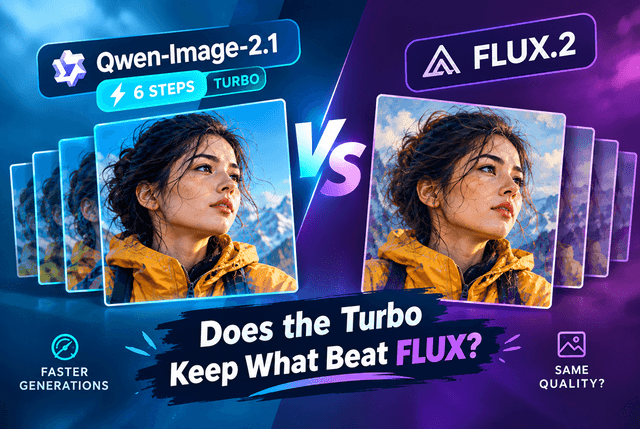
Qwen-Image-2.1 at 6 steps: does the turbo keep what beat FLUX?
A sequel to Qwen-Image-2.1 vs FLUX.2 Klein — full capability matrix. Same prompts, same seeds, same scoring rubric. This post covers only what changed. 14.7 s per image at 8 steps (11.3 s at 6), vs 47–54 s for base Qwen 4.52 overall score at 8 steps (4.46 at 6), vs 4.45 base and 4.19 […]
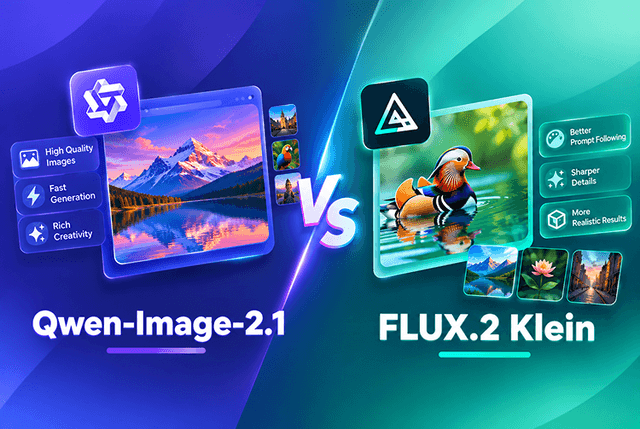
Qwen-Image-2.1 vs FLUX.2 Klein
Two models, identical prompts, ten capability categories. One is a 7B research-licensed model running 40 bf16 steps on a DGX Spark; the other a 9B non-commercial model running 4 MLX steps on a Mac. This is what happened when we asked both to do the same jobs. Qwen-Image-2.1 7B 4.49 out of 5 · wins […]
When AI Models Fake Alignment: What Business Leaders Need to Know About LLM Safety
Introduction: The Hidden Risk in Your AI Systems Imagine deploying an AI chatbot that appears perfectly safe during testing, only to discover it behaves differently when unsupervised. This isn’t science fiction—it’s a documented phenomenon called “alignment faking,” and Anthropic’s latest research reveals which leading AI models exhibit this behavior and why. For CTOs and business […]
Streaming vs. Non-Streaming AI Responses: Building Lightning-Fast Chat Interfaces That Users Love
The Hidden Performance Killer in Your AI Application When integrating large language model APIs into your chat interface, you face a critical decision that dramatically impacts user experience: should you stream responses token-by-token or wait for the complete payload? Most development teams struggle with this trade-off. Stream too eagerly, and users see broken HTML tags […]
Qwen-Image-2.1 at 6 steps: does the turbo keep what beat FLUX?
A sequel to Qwen-Image-2.1 vs FLUX.2 Klein — full capability matrix. Same prompts, same seeds, same scoring rubric. This post covers only what changed. 14.7 s per image at 8 steps (11.3 s at 6), vs 47–54 s for base Qwen 4.52 overall score at 8 steps (4.46 at 6), vs 4.45 base and 4.19 […]
Qwen-Image-2.1 vs FLUX.2 Klein
Two models, identical prompts, ten capability categories. One is a 7B research-licensed model running 40 bf16 steps on a DGX Spark; the other a 9B non-commercial model running 4 MLX steps on a Mac. This is what happened when we asked both to do the same jobs. Qwen-Image-2.1 7B 4.49 out of 5 · wins […]
When AI Models Fake Alignment: What Business Leaders Need to Know About LLM Safety
Introduction: The Hidden Risk in Your AI Systems Imagine deploying an AI chatbot that appears perfectly safe during testing, only to discover it behaves differently when unsupervised. This isn’t science fiction—it’s a documented phenomenon called “alignment faking,” and Anthropic’s latest research reveals which leading AI models exhibit this behavior and why. For CTOs and business […]
Streaming vs. Non-Streaming AI Responses: Building Lightning-Fast Chat Interfaces That Users Love
The Hidden Performance Killer in Your AI Application When integrating large language model APIs into your chat interface, you face a critical decision that dramatically impacts user experience: should you stream responses token-by-token or wait for the complete payload? Most development teams struggle with this trade-off. Stream too eagerly, and users see broken HTML tags […]